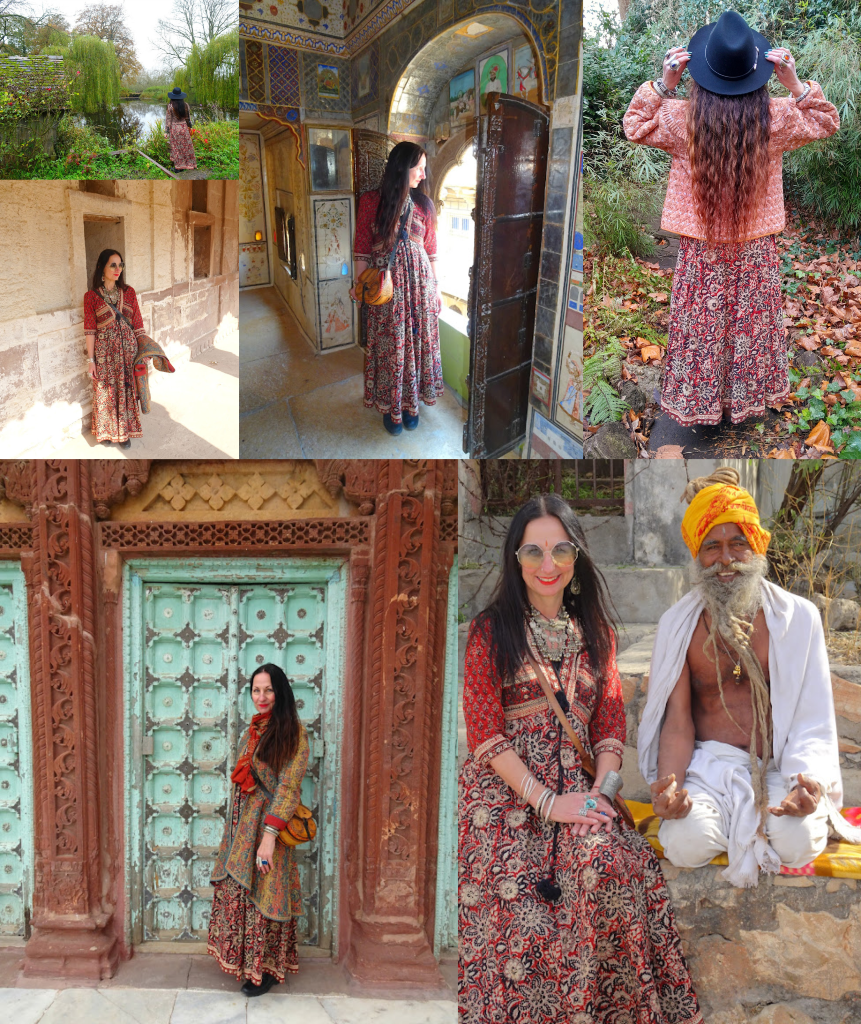
I was supposed to meet a friend for coffee this morning but unfortunately her house suffered the wrath of Storm Isha last night so she's awaiting a builder and we've postponed our date until next week.
I'm wearing an old favourite, an Anokhi maxi dress bought from their flagship store in Jaipur, Rajasthan's Pink City, back in January 2019 along with a reversible block printed jacket from Kharibu (from whom I bought my Pre-Raphaelite moss green velvet maxi).
This dress holds so many memories of India, from backpacking around Rajasthan, drinking in swanky bars in downtown Mumbai & staying in Portuguese-era heritage hotels in Goa to our closer-to-home travels in Greece and Spain along with National Trust days out, nights on the town, mornings spent rummaging the rails in the charity shops of the West Midlands and those endless days spent at home during Lockdown.
Two of my favourite memories were of risking life and limb to pose on a turret overlooking the 17th Century step well in Jodhpur and of having a chat with the saffron-turbaned sadhu in a remote village in Rajasthan where he asked me if I'd voted for Brexit (the answer, of course, was a resounding, No!)
Around the same time as I bought the dress, Bollywood royalty Sara Ali Khan was snapped by the Times of India wearing it around Mumbai although sadly, our paths never crossed.
I kept the Anokhi tag as, not being used to buying clothes from proper shops, having a fancy cardboard label attached to a garment remains a bit of a novelty and I've kept it in one of my travel journals for posterity. It describes the dress as a Cotton Peshwaz, which was said to be one of the most opulent forms of Moghul clothing for women. Originating in Persia, it was introduced to India during Babur's reign (1483 - 1530) and comprises of a fitted bodice with a full skirt which fastened at the waist (mine has a side zip). Due to the way the dress was cut at the front, women were required to wear a choli (blouse) underneath, my modern version came with a black cotton camisole top.
An early Twentieth century Peshwaz snapped when we visited in the National Museum of India in New Delhi in 2019
This 18th Century Peshwaz is on display in the V&A
My journal tells me that I paid 3350 rupees for my dress (around £35 back in 2019), expensive by Indian standards but to me, it's an absolute bargain for an ethically made, timeless classic and the memories entwined within the fabric are priceless.
With temperatures below zero for most of last week, eBay photos took a back seat and, in between swimming, charity shopping and socialising, when we met Liz & Al at the cinema for artisan pizza, red wine & another viewing of Poor Things, I managed to squeeze in some reading - finishing William Morris by Himself and Hilary Mantel's Beyond Black which, once I'd started, realised that I'd already read. On the pile this week are The Final Confession of Mabel Stark and A Scandalous Life: The Biography of Jane Digby (which I'm already halfway through).
Lady Jane Digby (1807 - 1881) - William Charles Ross
I first heard of Lady Jane Digby, a notorious aristocratic beauty born in Dorset in 1807, when we visited the mountain village of Doukades in Corfu (HERE) last year. At 17, Lady Jane married Lord Ellenborough, the governor-general of India and scandalised English society by having an torrid affair with her cousin before falling head over heels with an German prince, divorcing her husband and moving to Germany. After enjoying a close relationship with Ludwig I of Bavaria, she married Baron Karl von Venningenof Munich before embarking on an affair with the Greek Count, Spyridon Theotokis. After a duel between her love rivals she divorced the baron, converted to the Greek Orthodox faith and married Spyridon. The couple moved to his family home in Doukades. After the marriage broke down Lady Jane was rumoured to have had an affair with Greece's King Otto before meeting General Christodoulos Hatziperos, hero of the Greek War for Independence, where she acted as his queen, living in caves, riding horses and hunting. Lady Jane then travelled to the Middle East and fell in love withSheik Medjuel el Mezrab, who was twenty years her junior. The couple married under Muslim law and stayed together until her death 28 years later. Lady Jane adopted native dress, lived a nomadic lifestyle in tents in the desert and learned Arabic in addition to the eight languages in which she was already fluent. What a woman!
Lady Jane Digby in Palmyra (1859) by Carl Haag
The Kinky Shed is full to bursting after our fab friends Graz & Steve from Moseley Vintage Hub did some negotiating on our behalf and acquired a large personal collection of clothing amassed between the 1940s and 1980s and I've spent most of the weekend washing, steaming and sewing on buttons.
I couldn't resist snaffling this groovy wool-blend maxi dress, made by Shelana of London, a British Boutique label which ceased to exist sometime in the early '80s. Obviously this is from the 1970s with its have-yer-eye-out dagger collars!
Along with the job lot, we've managed to find some cool stuff recently, weather permitting I'll try and share a bit of it with you sometime soon. In the meantime I'll leave you with William who, this time last year, was just an occasional visitor to the garden.
Tuesday morning's sunrise was so beautiful that I temporarily abandoned my Wii Fit workout to dash outside and capture it on camera.
After breakfast, we walked down to the town centre vaccination centre for our Covid boosters. The doctor in charge (and a couple of the nurses) went into raptures over all the South Indian textiles I was wearing. The Hindu Kush dress & coat are both from Afghanistan, the zardozi work bag hails from Pakistan and my jewellery is Indian, Nepali, Tibetan and Turkomen.
Booster vaccines are mix and match so, as our first two vaccinations were Astra Zenica, our boosters were Pfizer. Previously as soon as we'd had our jabs we were free to go but, this time around, we had to sit in the observation area for fifteen minutes. It was quite busy and I'm glad to report that nobody keeled over!
We called into the cobbler's to collect the boots I'd left on the way to the pub on Friday, had a bit of a chat with him and were back home drinking coffee at the kitchen table by 10.30am.
My vintage lace-up boots, reheeled by our friendly cobbler for £5.99
I had to pose by these gates on the way back, they're in the next street and have been on my blog before. I just love the patina. If the homeowner who lives here ever gets them replaced I'll be straight in the skip hauling them out!
We'd heard numerous reports of ill-effects from the booster but both felt absolutely fine. As advised by the medical staff at the vaccination centre, we took a couple of paracetamol and then spent the afternoon photographing and listing stock on eBay, wrapping the sales and whilst Jon cooked tea, I lounged on the chaise reading Rummage, the book Vronni had sent me. I spoke to Liz for the first time since we'd lost Disco and Frank. Hopefully, we'll see each other next week.
The evening was spent in an equally lazy fashion, drinking rum & cola and watching an episode of Fake or Fortunewe'd not seen before, featuring this gorgeous painting by the celebrated Orientalist, Jean-Léon Gérôme, Arab at Prayer.
On Thursday morning we went into town (again!) to collect the dress I'd left with the tailor last Friday. It had needed a new zip and, as I've yet to find a Treacy Lowe dress for less than £400, I was a bit scared to do it myself. Just like with our lovely cobbler, it feels good to support a local, independent business.
It goes without saying that we had to pop into the clearance charity shop whilst we were in town. We left with three early 1960s handmade, back fastening blouses and two 1980s midi dresses as well as a couple of cool bits of vintage kitchenalia - a 1950s Nutbrown "sandwich toaster" and a 1970s Hamilton Dale "snack cooker". I was keen to try them but we'd got no bread in the house so it'll have to be a weekend project.
After 48 hours of drying on a rack over the bath, my new-to-me chazza-shopped merino wool jumper by Hush was finally ready to wear. I teamed it with a vintage '70s Anokhi shirt and maxi skirt and my uber posh Masscob for Liberty velvet jacket. My hair's had a bit of a growth spurt!
With the weather set to turn colder at the weekend, I cut down the last of the dahlias in the pot outside the front door, planted a pack of allium neopolitanum bulbs and covered the lot with compost. Hopefully, they'll look like this in six months' time!
The postman arrived with a parcel containing the two hand-printed, Indian cotton, ethically produced dresses I'd won on eBay last Friday and they were every bit as lovely as I'd hoped! Not bad for a fiver each.
While I photographed and listed some stock on eBay, Jon looked out his soldering iron and had a bash at repairing my Mum's bangle.
When I was a baby I teethed on the coin, which hung from this silver bangle Mum always wore. I never knew its origin and had always assumed it was something Dad brought back from his time in the Middle East. A couple of years ago I posted some photos on an ethnographic jewellery forum and nearly passed out when I was told that the silver coin dates from the Moghul era, cast during the reign of Aurangzeb (1658 -1707), the son of Shah Jahan who built the Taj Mahal (which we visited in 2018). It's definitely the oldest thing I've ever worn.
In other news, Lord Jon got a mention in this week's Guardian (HERE). Thanks for sharing, Annie!
On Friday, after my final Wii Fit workout of the week, I swept & mopped the downstairs floors & rugs and watered the houseplants. Whilst Jon did a tip run I took advantage of his absence and cleaned the kitchen.
After lunch I ironed some stock, Jon photographed it and I listed it on eBay. Needless to say that despite only going as far as the postbox I still got dressed, giving one of the dresses I'd bought from eBay it's first outing.
This dress features the ancient method of dabu, mud-resistant printing which can be traced back to the village of Akola in Rajasthan as far back as 675AD. The fabric is first washed to clear off surface impurities then the printing blocks are dipped in natural dyes and hand-printed on the plain fabric. A mud resistant mixture made with black clay, gum Arabic, lime and wheat husks is applied to the fabric and then dried. After drying, the fabric is dipped in a vat of dye, followed by a wash to remove excess dye and paste.
Oh look, there's me having a go at block printing at the Anokhi Museum in Jaipur, back in 2019. I can't wait to get back to India - fingers crossed for 2023!
Why have I not seen this video by Wales' finest, Goldie Lookin' Chain, before today? I've been crying with laughter all afternoon. Flat Earthers, look away now.....
I spotted this dress on eBay last week, it wasn't listed as vintage and was described as "Abigail's Party, perfect for a fancy dress party". I was the only bidder and won it for a song. Now I'm a big fan of Mike Leigh and loved Abigail's Party (link HERE) but fail to see any resemblance between this early '70s embroidered crepe maxi and Beverley's tiered polyester confection. As for fancy dress party, I wore it with my lavender Docs this morning for a trip to the DIY superstore. In my world every day is a fancy dress party.
I don't know about Easy like Sunday Morning, round here it's more like Freezy like Sunday Morning, it's positively Baltic out there today. We've lit a fire and abandoned all intentions of doing anything outside. I've been scrolling through our India photos, trying to recall the delicious 20°C winter warmth of Rajasthan just over eight weeks ago and realised I'd omitted to write about our trip to Amber Fort.
Better sort that out.
On the crest of a rocky hill seven miles north of Jaipur, Amber (often written as Amer) was the capital of the Kachchwaha Rajput clan from 1037 until 1727 when Jai Singh established his new city at Jaipur. Although Amber's buildings aren't as spectacular as those at Jaipur, the setting - perched high on a narrow rocky ridge above the surrounding countryside and fortified by natural hills and high ramparts - it is unforgettably dramatic.
It's a steep climb up from Amber town and you'll run the gauntlet of hawkers, beggars and itinerant musicians along the way. It is possible to visit the fortress on elephant-back but animal welfare groups have criticised the keeping of elephants at Amber (there's posters imploring tourists not to take elephant rides throughout Jaipur) because of reports of abuse and because of the carrying passengers can cause lasting injuries to the animals.
You'll enter through Sutaj Pole (the Sun Gate) which leads into the large Jaleb Chowk courtyard at the entrance to the main palace complex.
Jaleb Chowk courtyard
A steep flight of steps ascends to Singh Pole (Lion Gate), the entrance to the main palace. The architectural style is distinctly Rajput but, from the mirrored mosaics covering the walls, it's pretty clear that there was a strong Moghul influence.
Singh Pole leads to the first of the palace's main courtyards, on the far side of which is the open-sided pavilion known as Diwan-i-Am (Hall of Public Attendance), constructed in 1639.
Diwan-i-Am
Opposite, the exquisitely painted Ganesh Pole marks the entrance to a second courtyard, its right side filled with a miniature fountain-studded garden, behind which lie the rooms of Sukh Mahal. The marble rooms here were once cooled by water channeled through small conduits carved into the walls, an early and ingenious system of air conditioning.
Ganesh Pole
Sukh Mahal
On the opposite side of the courtyard the Sheesh Mahal contains what were the Maharajah and his queen's private chambers, the walls and ceilings are decorated with intricate mosaics fashioned out of shards of mirror and coloured glass. Beyond the Sheesh Mahal, on the far side of the courtyard, a narrow stairwell winds up to the small Jas Mahal, decorated with similar mosaics and guarded from the sun by delicately carved marble screens.
Sheesh Mahal
Sheesh Mahal
Sheesh Mahal
From the rear of the Sheesh Mahal courtyard, a narrow corridor transports you into another courtyard and the heart of the Palace of Man Singh I, the oldest part of the palace complex. The buildings here are plain and austere compared to the later structures, although they would have originally been richly decorated and furnished.
Below the palace, the atmospheric but little visited Amber town, is full of remnants of Kachchwaha rule as well as home to the Anokhi Museum of Hand Printing (which I wrote about HERE).
Amber Fort:
Admission fee Rs.550 for Foreign Tourists & Rs.100 for Indians
Timings: 10 AM - 5 PM (Daily)
Getting there: A cycle rickshaw takes around 40 minutes and costs Rs.400 (around £4) from Jaipur city.
I can feel the sun on my skin again (or is that the heat from the log fire?)