

Since we got back, the UK has been treated to some unseasonably mild weather, which means I don't have to pack away this year's Indian purchases just yet. Today I'm wearing an organic cotton, block-printed, wraparound skirt from Cottage Cottage, an up and coming ethical clothing chain we visit so regularly that the manager gives us a loyalty discount (Jon loves their short kurtas and shirts) and a dobby cloth tunic with bell sleeves trimmed with hand-woven Indian braiding from FabIndia. I wonder if our British High Street would be in such a sorry state if our clothes shops sold beautifully made, ethically produced garments as opposed to trend-led tat?

Anyway, back to the travelogue. Sorry about the profusion of posts but we packed a lot into the first fortnight and it'll be Easter if I don't crack on with them.
Remember this blog post about our fascinating walking tour of Dharavi in Mumbai, Asia's largest slum? Reality, the award winning tour company behind the trip, put 80% of their profits back into the community, which hugely impressed us so, this year, we signed up for a public transport tour of Delhi.

Our designated meeting place was outside the entrance to the Metro station in Delhi's swanky Connaught Place. Based upon the Royal Crescent in Bath, Connaught Place (or CP, as the locals call it) was designed by British architect John Wood the Younger and built between 1767 and 1774. The office space here is said to be the world's ninth most expensive.

Even the street dogs of CP are a bit posh. We watched in amazement as this chunky boy removed the screw top from his mineral water with his teeth and sipped from the bottle. No drinking from greasy puddles for this pooch!

Reality Tours allow a maximum of six people per tour and we got lucky as there were just the two of us that day. Without further ado, after meeting up with our guide for the day, Sarjan, the three of us jumped in a tuk tuk and off we went.

Our first stop was the Gurudwara Bangla Sahib, the oldest and most important Sikh gurdwara in Delhi. Constructed in 1783, it stands in the grounds of what was originally a bungalow belonging to Raja Jai Singh, the great Seventeenth century Indian ruler (more about him coming soon).
 |
| Guru Har Krishan (1656 - 1664) |
The eighth Sikh Guru, Guru Har Krishan resided here during his stay in Delhi. During that time, there was a smallpox and cholera epidemic, and the young Guru helped the suffering by giving aid and fresh water from the well at this house. Soon he too contracted the illness and died just before his 8th birthday in 1664. A small tank was later constructed by Raja Jai Singh over the well, its water is now revered as having healing properties and is taken by Sikhs throughout the world back to their homes.

The Sikh religion began in the 15th century in the Punjab. It was founded by Guru Nanak Dev who rejected the caste system of Hindus. Sikhism is the fifth largest religion in the world, the belief is that there is one God, and that all people are equal, men, women, different races and religions.
As you know, I'm not at all religious, but sitting cross-legged on the ice-white marble listening to the devotional hymns emanating from the inner sanctum of the temple whilst watching the sun break through the early morning mist & reflecting on the water in the bathing tank really was a spiritually uplifting experience.
 |

Within the temple grounds, people kept waving and shouting Mujhe Kanaada le chalo! As our Hindi is practically non-existent we were lucky to have Sarjan on hand to translate, Take me to Canada! The dream destination for many Sikhs. Forget America (Trump) and the UK (Brexit), Canada has a Sikh minister of defence, what a wonderful country!

At gurdwaras the world over, every day of the year, volunteers and workers cook free vegetarian meals for anyone who wants to eat, regardless of their background and because equality is so important in the Sikh religion, everyone who comes in eats at the same level in the dining hall. You'll see an immaculately dressed businessman eating beside a homeless person. Many street children in India use Sikh temples to keep from starving.
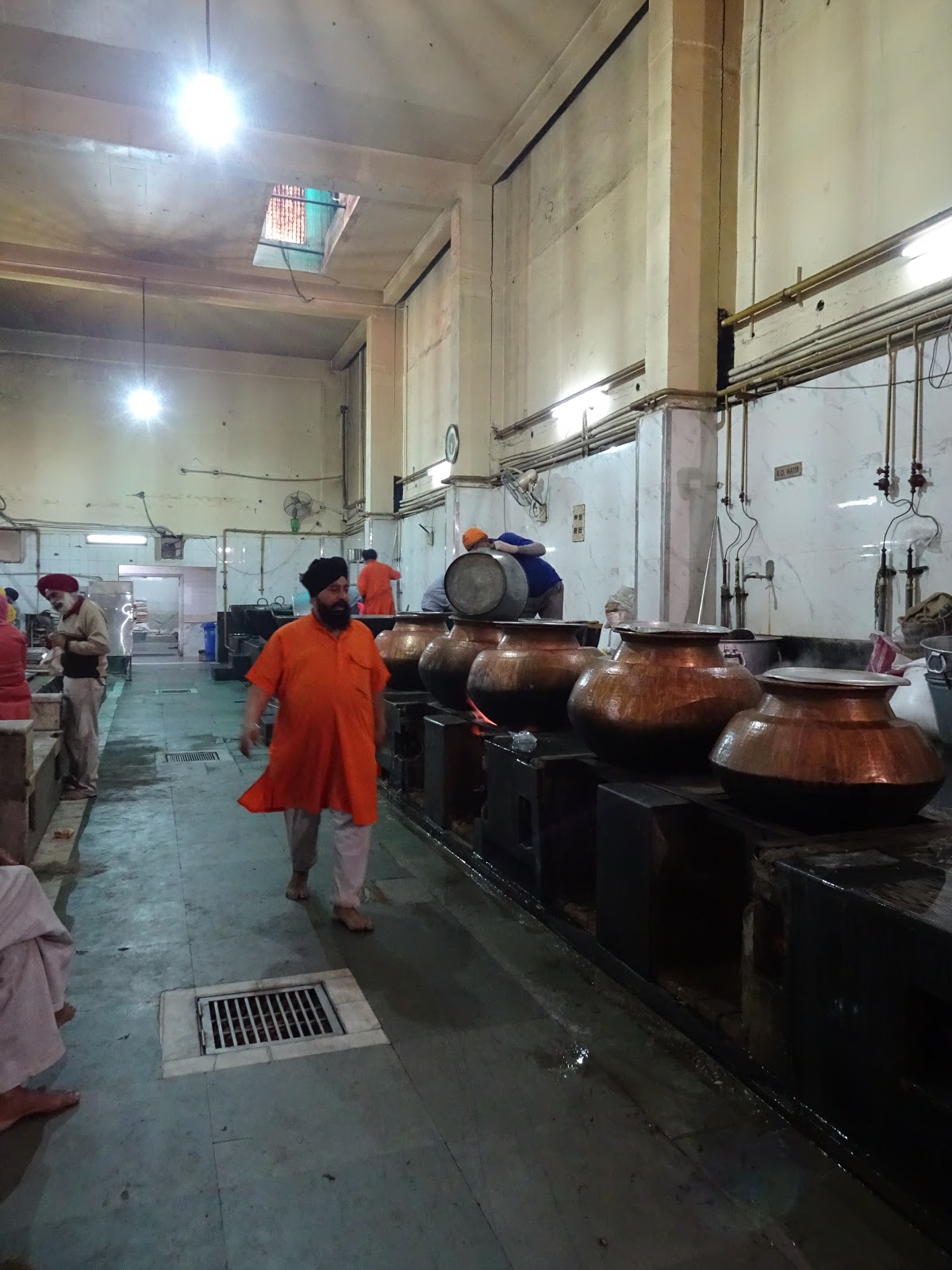
At the Gurudwara Bangla Sahib approximately 25,000-30,000 people eat at the langar (dining room) every day so catering for the diners is a major operation.

We'd already eaten breakfast so didn't stay to eat but, judging by the lunch we ate at a gurdwara in Gujarat last year, I've little doubt that it would have been delicious.

Next we boarded a single decker bus and headed to Rajpath to see Sansad Bhavan (Parliament House) and Rashtrapati Bhavan (the prime minister's residence) both designed by the British architect Sir Edwin Lutyens. Parliament was officially opened in January 1927 by the then Viceroy of India, Lord Irwin. As Republic Day was approaching, the police were on high alert and most of the surrounding roads were closed in readiness for the world famous march due to take place on 26th January.

Fortunately for us, Sarjan managed to persuade the armed police guard that we were respectable, middle-aged British tourists and not crazed terrorists and with a wink and a smile, they lowered their rifles and allowed us through the road blocks where we were privileged to get a sneak preview of the Royal Bodyguard practicing their Republic Day march past. We waved at them as we got into the nearest tuk tuk and they tried their hardest not to break into huge grins.

The India Gate is a war memorial located further down the Rajpath, on the eastern edge of New Delhi.Like the parliament buildings, the memorial was designed by Lutyens and was unveiled by the then Viceroy, Lord Irwin, on 12th February 1931.

Of the 13,218 Commonwealth servicemen commemorated on the memorial, around 1,000 lie in cemeteries to the west of the River Indus, where maintenance was not possible. The remainder died in fighting on or beyond the North West Frontier and during the Third Afghan War, and have no known grave. The Delhi Memorial also acts as a national memorial to all the 70,000 soldiers of undivided India who died during the years 1914-1921, the majority of whom are commemorated by name outside the confines of India.

In 1972, following the Bangladesh war, a structure consisting of a black marble plinth, with a reversed rifle, capped by a war helmet, bounded by four eternal flames, was built beneath the Memorial Archway. This is called Amar Jawan Jyoti, or the Flame of the Immortal Soldier, and since 1971 has served as India's Tomb of the Unknown Soldier.

Amar Jawan Jyoti is manned round the clock by soldiers drawn from the three services of the Indian armed forces, the army, the navy and the air force.


By the time we'd hailed another tuk tuk we'd spent a few hours with Sarjan and after discussing work, countries & places in India we'd visited and Brexit (arghhhh...there's no escape), the conversation turned to Bollywood and the three of us squashed into the tiny two seater and sung Piya Tu Ab To Aaja all the way to our next destination, Lodi Gardens.
 |
| The tomb of Mohammed Shah (Circa 1444) |
Popular with courting couples, film makers and yoga groups, Lodi gardens is a city park spread over 90 acres and houses tombs that date back to the Sayyid Dynasty, the earliest being built in 1444.

During the British Raj, it was landscaped by Lady Willingdon, wife of Governor-General of India, Marquess of Willingdon, and named the 'Lady Willingdon Park' upon its inauguration in 1936, but in 1947, after Independence, it was given its present name, Lodi Gardens.

Another tomb within the gardens is that of Sikander Lodi, built by his son Ibrahim Lodi in 1517, the last of Sultan of Delhi.

Sarjan grew up in Delhi, he told us that he played hide and seek with his school friends within the tombs, incurring the wrath of the park's guards.


In the middle of the gardens is the Bara Gumbad (Big Dome), it consists of a large rubble-construct dome and it is not a tomb but a gateway to an attached a three domed mosque (both built in 1494).

This chai wallah has made himself at home .


From here we took a cycle rickshaw and had lunch in Sarjan's favourite eaterie, Hot Chimney, for a massive vegetarian feast.

We'd done tuk tuks, cycle rickshaws and buses so, after lunch, it was the turn of the Metro. Opening in 2002, Delhi's Metro is the world's 9th longest and carries 2.6 million passengers daily. It's immaculately clean, very secure (the entrances are manned by armed security guards and passengers have to pass through airport-style scanners) and extremely cheap. Unlike the Underground, outside of rush hour, you can usually get a seat and your fellow passengers will smile at you and make conversation.

Our destination?

The Masjid-i Jahān-Numā, one of the largest mosques in India - it can accommodate a mind-blowing 25,000 worshippers. It was built by Mughal Emperor Shah Jahan (he of Taj Mahal fame) in 1656 and constructed by around 5000 workers.

We visited on a Friday, the most important day of the week for Muslims, and it felt like there was a capacity crowd. Of course, we were the only foreigners to be seen and once we'd been spotted that was it - whilst Jon struck gangster-type poses with the guys, I was handed newborn babies and urged to pose with my arm around small children and shy ladies. Luckily Sarjan explained that we were on a tight schedule and we were able to flee to an awaiting rickshaw.


Our final destination of the day was Delhi's Red Fort, until 1856 the main residence of the emperors of the Mughal dynasty for nearly 200 years. Constructed in 1639 by Shah Jahan, the Red Fort is named for its massive enclosing walls of red sandstone. The fort complex is considered to represent the marvel of Mughal creativity containing architectural elements that reflect a fusion of Persian and Hindu traditions.

The fort was plundered of its artwork and jewels during Nadir Shah's invasion of the Mughal Empire in 1747 and most of its precious marble structures were subsequently destroyed by the British following the Revolt of 1857 although the fort's defensive walls were largely spared, and the fortress was subsequently used as a garrison.
Every year on the Independence day of India (15 August), the Prime Minister hoists the Indian flag at the main gate of the fort and delivers a nationally broadcast speech from its ramparts.

Time for one last photo before the selfie-taking hoards descended (where were all the other foreigners?) Jumping back on the Metro we said our goodbyes to Sarjan and headed back to Paharganj to pack our bags. We were leaving Delhi and heading to Rajasthan early in the morning.


